






















Classic planning rules usually pursue a single objective:forward scheduling based on due dates, backward scheduling for capacity leveling, or minimizing setup times.In reality, however, multiple—sometimes conflicting—objectives must be considered simultaneously:
- On-time delivery
- Inventory reduction
- Setup optimization
- Cost minimization
- Energy efficiency
The MCP weighting rule extends Opcenter APS with a strategic control logic.With each planning run, you define which objectives have priority—and how they are weighted.Depending on the planning horizon, maximum utilization can be achieved in the short term, while medium- and long-term planning ensures on-time scheduling without unnecessary capital commitment.The result is a fast, constraint-compliant planning run with clearly defined economic objectives.

Key weighting criteria include
From demand forecasting to distribution, Sunstice enables integrated management of the food supply chain and delivers measurable economic impact across all planning levels.
On-time delivery / slack time
Orders are prioritized according to their urgency. The weighting determines how strongly due dates are considered compared to other objectives.
Setup and cleaning times
Lead times
Idle times between operations are minimized to reduce work in progress (WIP) and lower capital tied up.
Costs
Machine and resource costs are incorporated into the decision logic, ensuring that economically optimal alternatives are preferred.
Energy costs
When energy data is integrated, energy-intensive processes can be shifted to more cost-efficient time windows—enabling active peak shifting and reduced energy costs.
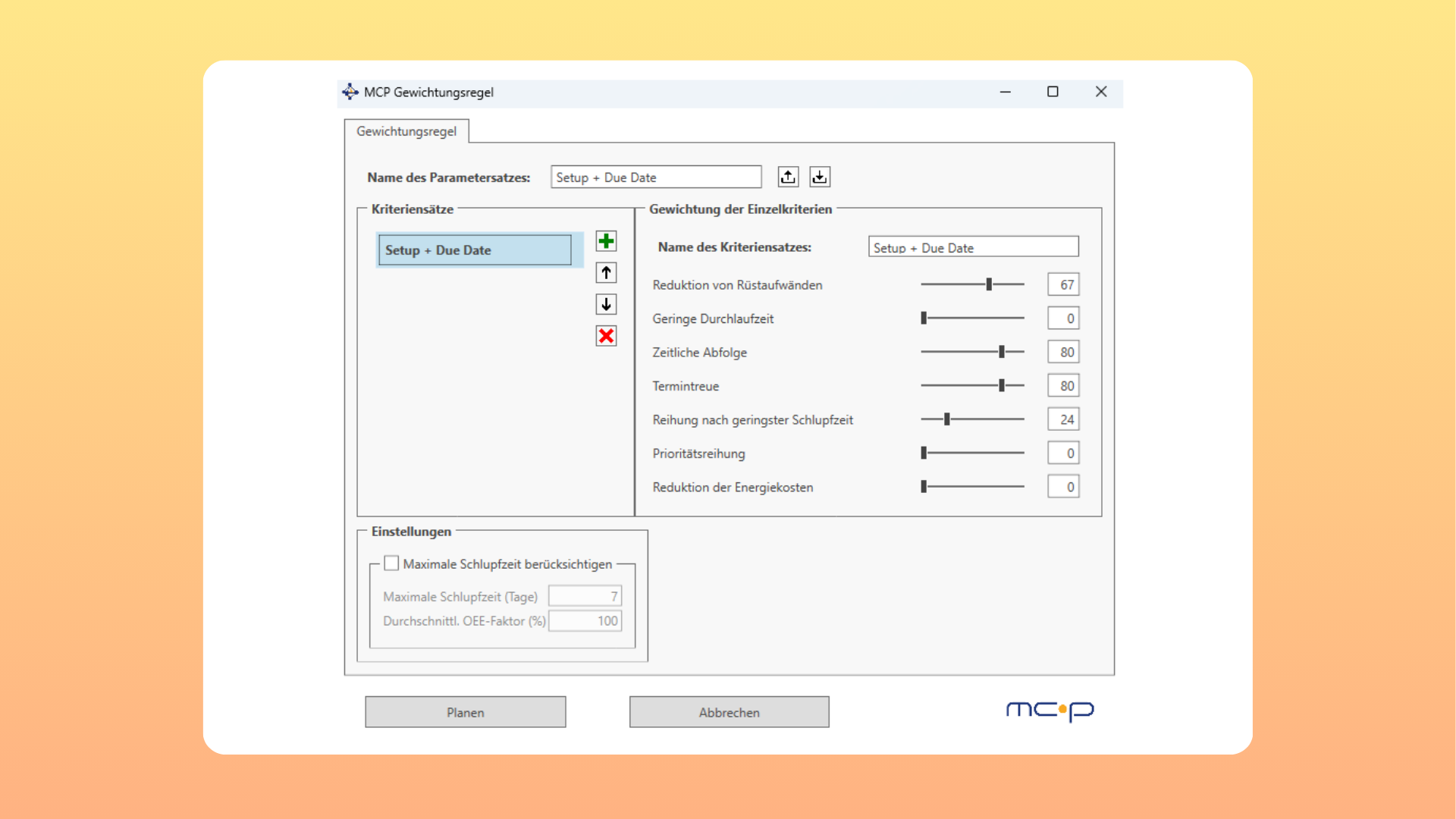
How the MCP weighting rule works in practice
Leverage your planning as a strategic lever
The MCP weighting rule reveals the potential of a strategically controlled production planning approach.
As part of a structured potential analysis, we assess which economic effects are realistically achievable in your specific environment—aligned with your objectives, constraints, and market requirements.
You will receive a well-founded assessment of productivity, inventory development, delivery performance, and implementation effort.