





















Especially in process industries—such as the food or chemical industry—silos and tanks are not secondary constraints, but central bottleneck resources.Capacity limits, permitted contents, cleaning cycles, and logistical dependencies directly influence production sequencing, lead times, and inventory levels.If these factors are not systematically integrated into production planning, this results in:
- Unplanned downtime
- Unnecessary stock movements
- Increased cleaning effort
- Reduced equipment availability
- vermeidbare Kapitalbindung
The MCP silo and tank planning fully integrates these constraints into Opcenter APS—enabling realistic and economically robust detailed scheduling.
Relevant factors include:
">Available capacity and current fill levels are dynamically incorporated into the planning process.
Permissible weight
Maximum weight limits and product-specific load constraints are considered in compliance with all restrictions.
Accessibility
Equipment and pipeline logic determine which silos or tanks can actually be used at which point in time.
Existing content
Current fill levels influence possible downstream processes and production sequences.
Permitted content
Product groups, quality requirements, and contamination risks are ensured and safeguarded within the planning process.
Preferred usage
Strategic preferences—such as reducing cleaning cycles—can be specifically taken into account.
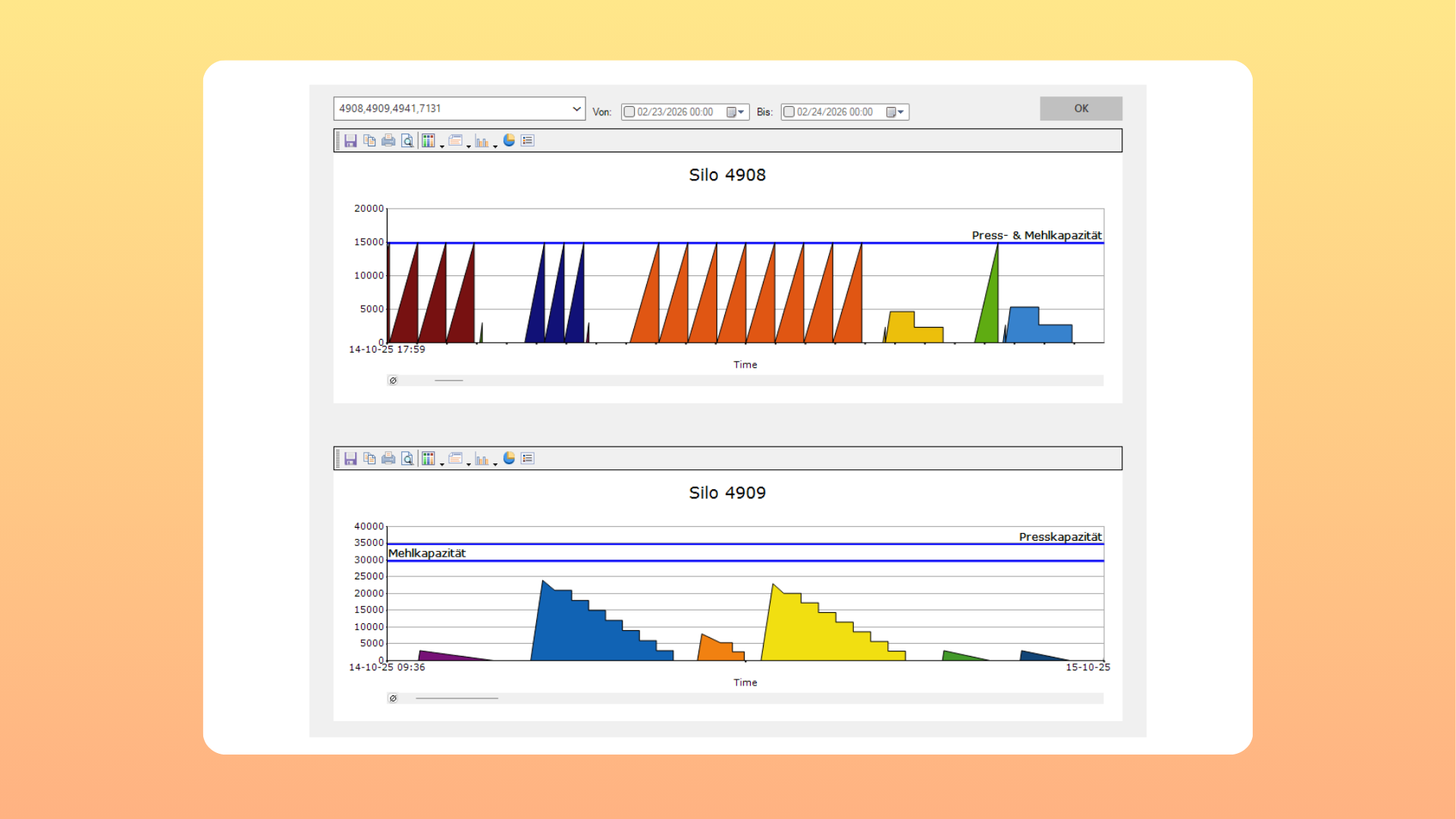
This is how silo and tank logic is fully integrated into detailed scheduling
- temporal overlaps
- minimum and maximum fill levels
- product-specific content constraints
- cleaning requirements
- logistical dependencies between machines
- Higher process stability in continuous production environments
- Reduction of unplanned downtime
- Reduced cleaning and changeover efforts
- better utilization of storage resources
- transparente Belegungsübersicht
- Realistic simulation of alternative planning scenarios
Stabilize your process production strategically
As part of a structured potential analysis, we assess the extent to which silo and tank constraints impact your production performance and what optimization potential can realistically be achieved through integrated planning.
You will receive a well-founded assessment of stability effects, utilization potential, and implementation effort.